How Roasting Degree Influences Extraction In Filter Coffee
Introduction
Roast degree is one of the most consequential variables in coffee production. It determines solubility, flavour development, and structural integrity of the bean — yet its precise relationship to extraction yield is rarely examined under controlled conditions. This report presents data from a controlled roasting experiment conducted in October 2023 on a single Honduras SHG EP lot, exploring how six roast degrees influence extraction yield when all brew parameters are held constant.
The central question is straightforward: as roast degree increases, what happens to extraction yield? The answer has practical implications for roasters calibrating production profiles, and for anyone seeking to understand coffee as an interconnected system of decisions rather than a collection of isolated techniques.
Coffee & Roast Parameters
The coffee used in this experiment was a Honduras SHG EP (Strictly High Grown, European Preparation), sourced from COMSA — a cooperative of smallholder producers in the Marcala region. The green coffee was processed using the washed method, and represents a blend of field varieties from a single organisation rather than a single-cultivar lot.
Washed processing was relevant here because it produces a relatively clean, structurally consistent green coffee — reducing the variable of residual mucilage or uneven drying that might otherwise complicate interpretation of the roast data.
The experiment used a production roaster (RDRF 20) with a batch size of 400kg. The roast profile was designed with a total roast time of 10 minutes and 20 seconds. Six samples were taken at progressive roast degrees — 190°, 194°, 198°, 202°, 206°, and 211°. These degrees were selected to capture the coffee before, during, and after first crack.
The first two samples (190° and 194°) were taken before first crack; the remaining four (198° onwards) were taken during and after it. This distribution provides a continuous view of how structural and chemical changes across this critical phase translate to extractability.
Brew Methodology
All six samples were brewed using a Pulsar brewer — a no-bypass percolation device — selected for its ease of replication and its ability to produce TDS measurements that reflect the full brew concentration without water bypassing the filter bed. This is an important distinction: in bypass brewing methods, a portion of water skips the coffee bed entirely, diluting the final cup and making TDS a less direct proxy for extraction. With no-bypass percolation, TDS directly represents what was extracted through the full dose.
Brew parameters were held constant across all six samples: a dose of 15g, a 1:17 brew ratio, a ZP6 grinder at setting 4.1, and water just off boil. Brew times ranged from 02:30 to 02:40 across all six samples — a variance of 10 seconds, which is within normal replication tolerance. Output yield ranged from 218g to 220g, confirming consistent execution across the set.
One nuance is worth noting: while the grind setting was held constant, roast degree itself influences particle size distribution. Darker roasts are more brittle and produce different grind distributions at the same setting. The distribution figures in the data — ranging from 846 to 934 — reflect this: lighter roasts produced wider distributions, indicating a coarser or more varied particle spread, while darker roasts produced lower, more uniform distributions. This is not a confounding variable to be controlled away; it is part of the causal mechanism by which roast degree influences extraction.
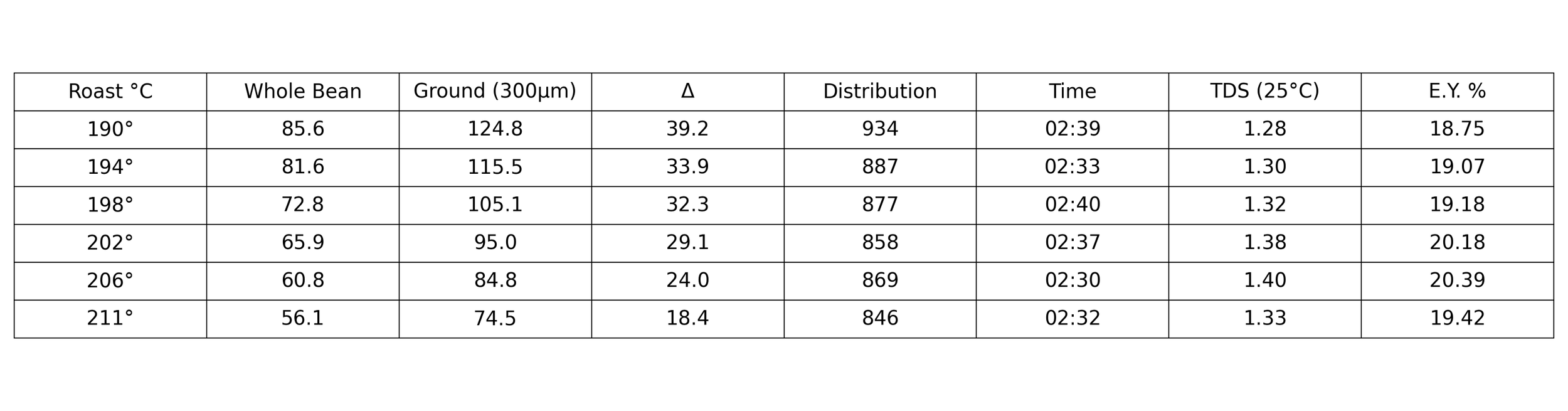
Table 1. Roast degree, colorimetry, brew parameters, TDS, and extraction yield across six samples of Honduras SHG EP (COMSA).
Brewer: Pulsar (no-bypass percolation). Grinder: ZP6 at setting 4.1. Dose: 15g. Water: just off boil.
The Relationship Between Roast Degree and Extraction Yield
The data shows a clear pattern: extraction yield increases as roast degree darkens, up to a point. From 190° to 206°, extraction yield rises progressively from 18.75% to 20.39%. At 211°, however, extraction yield declines to 19.42% despite the darkest roast degree in the set. Notably, the two lightest samples — 190° and 194°, both taken before first crack — show the lowest extraction yields in the set (18.75% and 19.07%), reflecting the limited solubility development that occurs prior to the structural changes first crack initiates. This non-linear trajectory is the most important finding in the dataset.
The ascending phase — 190° to 206° — is consistent with what roast chemistry predicts. Before first crack (190° and 194°), the bean is still dense and relatively intact; CO₂ pressure is building internally but cell wall rupture has not yet occurred, limiting solubility. At first crack and beyond, cell wall structures break down, CO₂ degasses, and complex carbohydrates and proteins degrade into more soluble compounds. The bean becomes physically more porous and chemically more extractable. All else equal, a darker roast should yield more dissolved material in the cup for the same brew parameters — and the data confirms this.
The decline at 211° is equally predictable but often overlooked. Beyond a certain roast degree, soluble compounds begin to degrade rather than accumulate. Sugars caramelise and then carbonise. Organic acids break down. The very compounds that were becoming more soluble now volatilise or polymerise into insoluble forms. The result is a roast that is structurally open and grinds finely but has less total soluble material to offer — hence the drop in both TDS (1.33) and extraction yield (19.42%) at 211°.
The Whole Bean to Ground Color Difference
The difference between whole bean and ground color narrows consistently as roast degree increases — from 39.2 at 190° to 18.4 at 211°. This metric reflects the degree of internal development: a large gap between whole bean and ground color indicates that the exterior of the bean has roasted faster than the interior. As roast degree increases, heat has had more time and intensity to penetrate the bean uniformly, closing the gap.
For extraction, this matters because ground color is a more accurate proxy for the material the brewer actually contacts. At lighter roast degrees, whole bean color is higher (lighter exterior) while ground color is even higher still (lighter interior) — the core of the bean is less developed than the surface. This produces uneven solubility across the particle: the exterior, having received more heat, is more soluble than the underdeveloped core. The narrowing difference at darker roasts is a direct consequence of roast development — as heat penetrates the bean more fully over time, the interior catches up with the exterior, producing a more uniform structure from surface to core.
Grind Distribution as a Mediating Variable
The grind distribution figures deserve specific attention. At 190°, distribution is 934; by 211° it has fallen to 846. A higher distribution generally indicates a wider spread of particle sizes — more fines and more coarse particles simultaneously. This is characteristic of lighter roasts, which are denser and harder, and tend to shatter unevenly under grinding force.
This matters because fines extract faster and more completely, while coarse particles under- extract. A lighter roast with higher distribution may paradoxically produce both over-extracted fines and under-extracted coarse particles in the same brew, resulting in a lower overall extraction yield despite the presence of highly extractable fines. The reduction in distribution at darker roasts, combined with lower cell wall density, produces a more consistent particle size profile — one reason the extraction yield rises even as the absolute solubility of individual compounds begins to plateau.
Conclusions
This experiment supports several conclusions applicable to production roasting and brew calibration.
First, roast degree has a measurable and non-linear effect on extraction yield when brew parameters are held constant. Yield increases from light to medium-dark, then declines at the darkest roast degrees tested. For this coffee and this brew method, peak extraction yield occurred at 206°.
Second, the mechanism is not simply ‘darker is more soluble.’ The relationship is mediated by at least two additional variables: the degree of internal development (whole bean to ground color difference) and the grind particle distribution produced at a given roast degree. These variables shift together as roast degree changes, and together they explain why darker roasts extract more efficiently up to a threshold.
Third, the extraction decline at 211° is a reminder that roasting beyond the point of peak solubility development does not continue to increase extractability. It is possible to roast past the point of maximum yield, producing a coffee that is structurally open but chemically depleted — a consideration particularly relevant in production contexts where consistency of extraction across large batches is a priority.
Finally, no-bypass percolation as a brew method proved well-suited to this kind of analysis. The direct relationship between TDS and extraction without bypass dilution makes the data cleaner and the conclusions more direct. Roasters seeking to assess the extractability of a roast profile would benefit from adopting a consistent no-bypass reference brew as part of quality control.
