The 6 Things You Need to Know About Coffee Fermentation
Book Review: The Art and Science of Coffee Fermentation
Coffee fermentation has become one of the most talked-about topics in specialty coffee. Terms like anaerobic, carbonic maceration, and co-fermentation are now common, yet the underlying understanding of what fermentation actually is often remains vague.
The Art and Science of Coffee Fermentation attempts to bring scientific clarity to this space. While the book is technical in places, its core ideas are surprisingly simple. More importantly, those ideas challenge some of the assumptions that have become normalized in coffee.
If you understand the six points below, you understand most of what the book is trying to communicate—and a few things it unintentionally reveals.
1. Fermentation and Processing Are Not the Same Thing
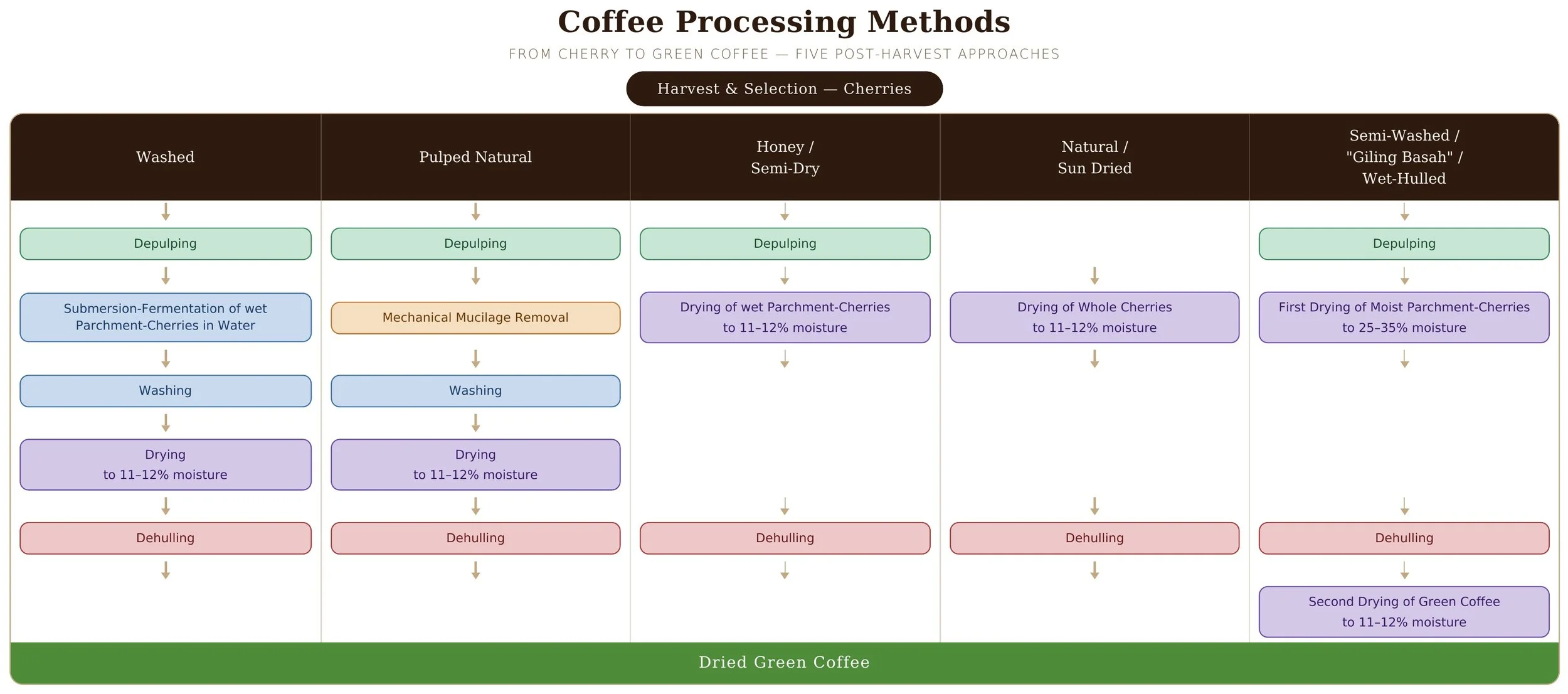
The first and most important distinction is that fermentation and processing are not the same thing. In coffee, these terms are often used interchangeably, but they describe fundamentally different phenomena. Processing refers to the physical steps applied to the coffee cherry—depulping, washing, drying, and dehulling. Fermentation, on the other hand, is a biological process driven by microorganisms interacting with the compounds in the coffee fruit.
Processing methods do not define fermentation; they create the conditions under which fermentation occurs. This distinction may seem subtle, but it fundamentally changes how we interpret everything that happens after harvest.
2. Microorganisms Are Always Present
Fermentation is not something introduced into coffee—it is already happening. Microorganisms such as yeasts, bacteria, and fungi are naturally present on the coffee cherry and begin acting immediately after harvest.
These organisms consume sugars and produce metabolites such as alcohols, acids, and esters, altering the chemical environment around the seed. This means that every coffee undergoes fermentation. The relevant question is not whether fermentation occurs, but how it unfolds and under what conditions.
3. Terroir May Be Microbial
Once fermentation is understood as a microbial process, a more interesting possibility emerges: what we call terroir may partly be microbial.
Microbial activity is shaped by environmental factors such as sugar concentration, climate, altitude, temperature variation, time, water activity, pH, and oxygen availability. These variables determine which microorganisms thrive and which metabolic pathways dominate.
If microbial communities differ across regions—and if those communities influence fermentation—then terroir may extend beyond soil and climate to include microbial ecosystems shaped by those conditions. While the book does not fully develop this idea, it is one of its most compelling implications.
4. Yeast Plays a Central Role
Within this microbial system, yeast plays a central role, particularly in the early stages of fermentation. Yeasts are present across nearly all processing methods and initiate the breakdown of sugars.
In doing so, they produce ethanol, carbon dioxide, and a range of secondary metabolites including esters, acids, aldehydes, and ketones. These compounds can influence the acidity and aromatic potential of the coffee.
One of the more interesting implications is that reducing or minimizing yeast activity—such as in highly controlled washed processes—may lead to a flatter or less expressive cup. This challenges the assumption that “clean” processing necessarily produces more desirable flavor.
5. Processing Choices Are Environmental Choices
Processing decisions are not only about flavor—they are also environmental decisions. Washed processing requires significant amounts of water, often between 20 and 90 liters per kilogram of cherries. The resulting wastewater contains organic compounds, microorganisms, and acids that can damage ecosystems if not properly treated. It is often highly acidic, with a pH around 4.
Natural processing, by contrast, uses little to no water and generally has a lower environmental impact, although it introduces its own challenges related to drying and consistency.
This dimension of processing is rarely emphasized in specialty coffee, but it is essential if fermentation is to be understood in a broader agricultural and environmental context.
6. Pulped Natural and Honey Processing Are Not the Same
A common misconception in coffee is that Pulped Natural and Honey processing are essentially the same. They are not.
In Pulped Natural processing, the coffee is depulped and then undergoes mechanical mucilage removal and washing before drying. This results in less mucilage remaining on the seed and therefore less fermentation during drying.
In Honey processing, by contrast, varying amounts of mucilage are intentionally left on the seed, and the coffee is dried with that layer still intact. This creates a more active fermentation environment and typically leads to greater body and sweetness in the final cup.
The distinction may seem technical, but it reflects a broader issue: coffee terminology often becomes imprecise exactly where precision matters most.
Final Thought
The Art and Science of Coffee Fermentation is valuable because it reframes coffee processing as a biological system shaped by microorganisms, environmental conditions, and human decisions.
At the same time, it makes clear that fermentation in coffee is not fully understood and is often oversimplified in industry discourse.
What emerges is a picture of fermentation as something that sits between science and interpretation—grounded in microbiology, influenced by environment, and shaped by processing, but not yet fully predictable.
