Methods of Coffee Brewing: Immersion vs Percolation
Brewed coffee requires only two ingredients: ground coffee and water. Yet dozens of devices, techniques, and rituals surrounding its preparation. Espresso machines, French presses, V60s, batch brewers, Aeropress, Clever drippers — the variety can make brewing appear more complex than it is.
Strip away the equipment, however, and nearly every brew method falls into one of two physical categories: immersion or percolation.
Understanding this distinction simplifies brewing considerably. It shifts the focus away from devices and toward extraction mechanics.
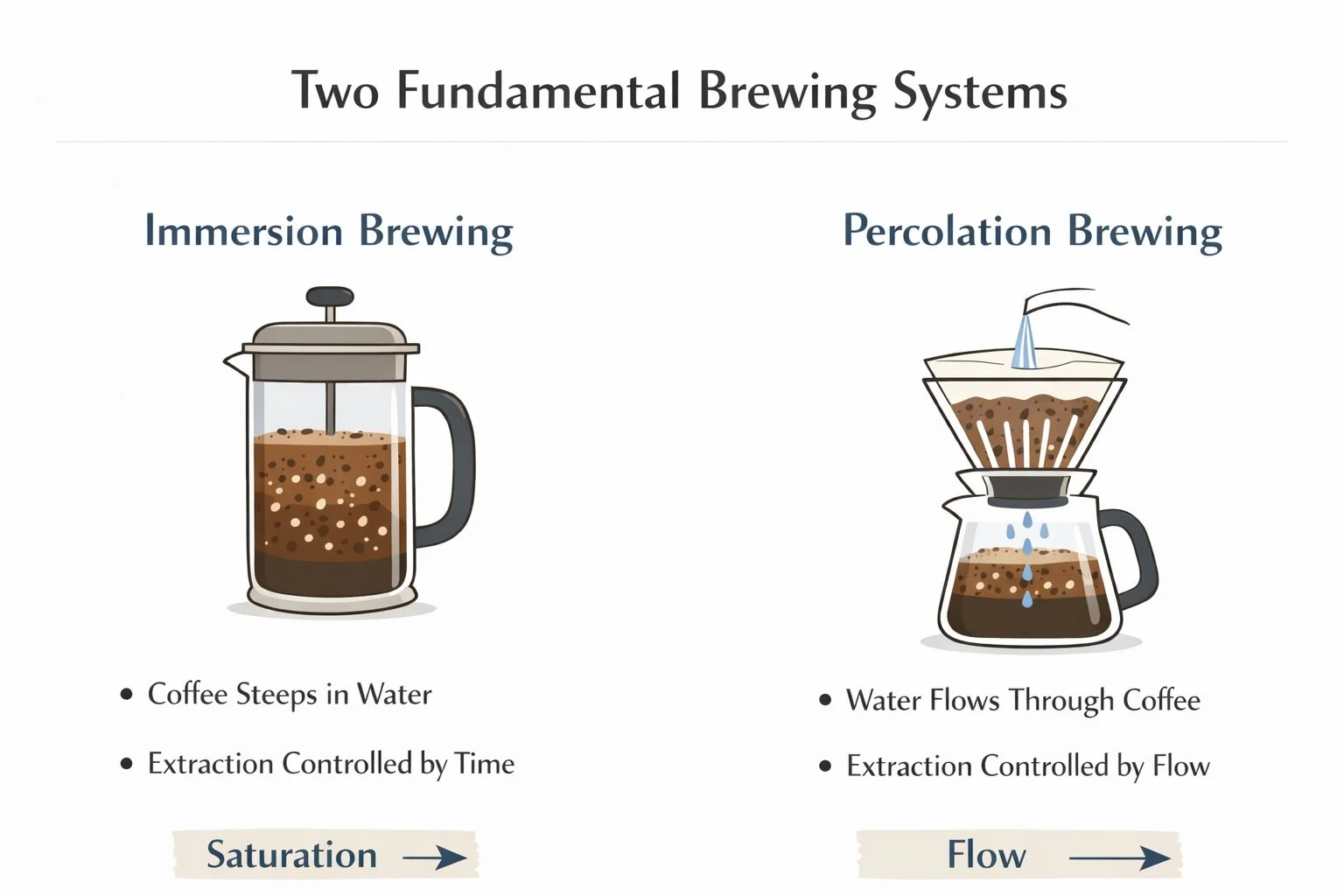
Immersion brewing occurs when all of the brewing water and all of the ground coffee remain in contact for the entire duration of the brew. The liquid gradually becomes more concentrated as compounds dissolve into the water. As extraction progresses, the concentration gradient between water and coffee decreases, slowing further extraction. Given sufficient time, immersion methods provide a broad and relatively even representation of the coffee’s soluble composition.
Because the solvent becomes increasingly saturated over time, extraction efficiency decreases naturally. This can produce a cup that feels rounder and slightly softer in structure. Slower-extracting compounds may be less emphasized within typical brew times, but the overall profile often reflects a balanced composition. French press, cupping, Clever dripper, and certain Aeropress preparations are all examples of immersion brewing.
Percolation operates differently. Instead of allowing water and coffee to sit together, fresh water is continuously introduced and passed through the coffee bed. This maintains a higher concentration gradient and increases extraction efficiency. As clean water moves through the grounds, it dissolves soluble compounds quickly, particularly those that extract rapidly.
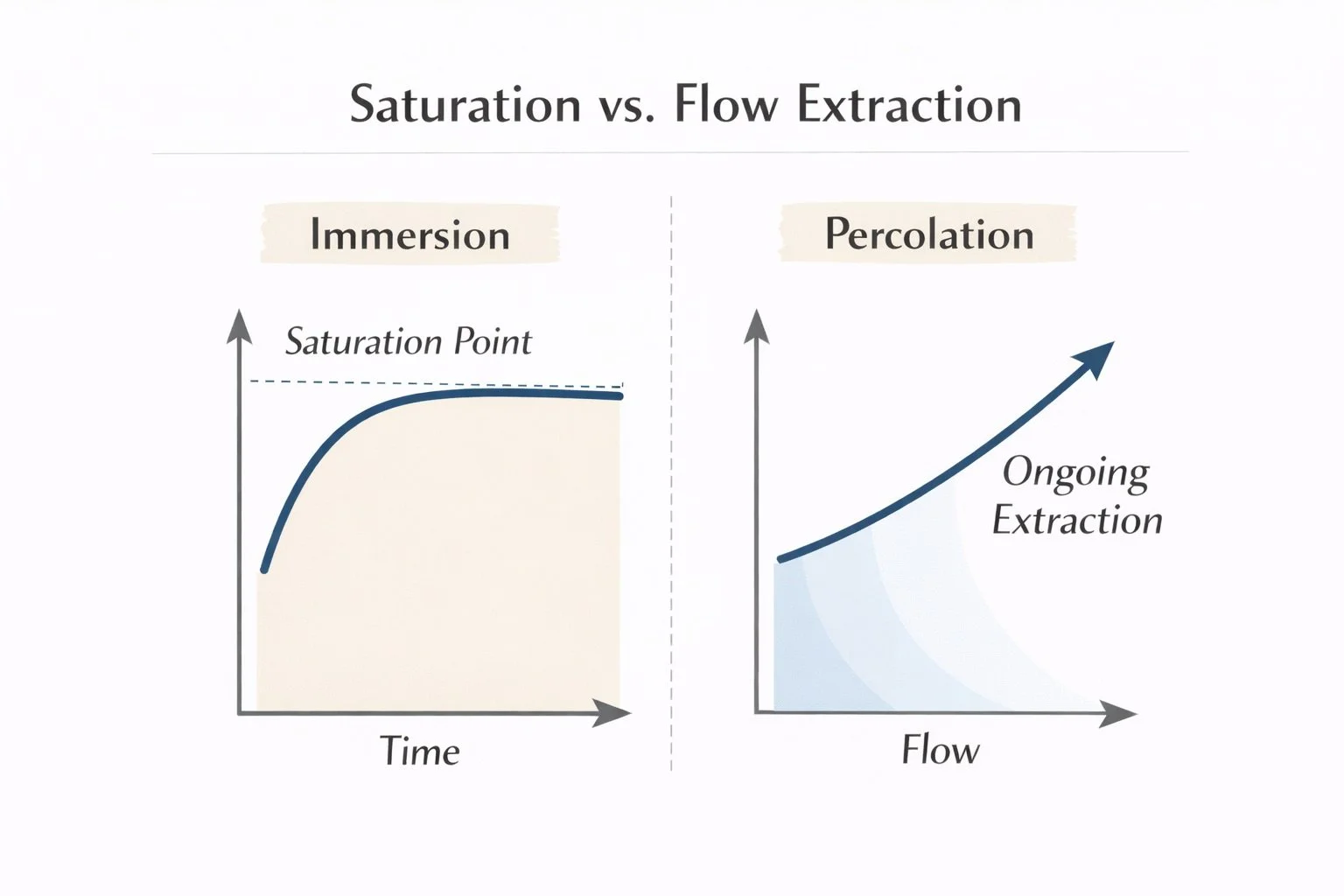
This mechanism often accentuates brightness and perceived acidity, as rapidly dissolving compounds dominate early extraction. Because extraction efficiency is higher, percolation brews typically require less coffee to achieve a similar strength compared to immersion methods. However, the dynamic flow of water introduces new variables. Flow rate, turbulence, and resistance within the coffee bed all influence how evenly extraction occurs.
Water, like any fluid, moves through the path of least resistance. If the coffee bed is uneven, if grind size distribution is inconsistent, or if flow is disrupted, channeling can occur. In such cases, certain areas of the coffee bed may be over-extracted while others remain under-extracted, potentially leading to imbalance or astringency. Batch brewers and manual pour-over methods such as the V60 or Kalita Wave fall into this category of percolation.
Neither immersion nor percolation is inherently superior. They are simply different extraction environments. One allows concentration to build gradually within a closed system. The other maintains solvent strength through constant renewal.
The practical difference lies not in equipment preference, but in how these mechanics shape flavor structure. Immersion tends to emphasize completeness and integration – often why it is used by coffee professionals when evaluating sample offers, production roasts, and determining flavour note descriptors. Percolation often highlights clarity and definition. Often why it is the choice preference in the specialty coffee movement. Each method offers a different lens through which a coffee can be experienced.
At its core, the difference between immersion and percolation is simply the difference between water sitting with coffee and water moving through coffee. Once that distinction is clear, many brewing variables begin to make sense. Flow rate, grind size, brew time, and even perceived acidity are easier to understand when viewed through this lens. Brewing does not have to be complicated.
Once the mechanics of extraction are understood, many brewing variables begin to explain themselves.
