World of Coffee: A Push for Standardization
Last week I attended World of Coffee in Brussels. Beyond the chance to meet friends, colleagues, clients, and producers, it was an opportunity to see where the industry's thinking is heading — and to put my own research in front of a room of practitioners willing to challenge it.
This was my first time presenting a workshop at an event of this size. I chose to showcase the research connecting roast color to preference identification and roastery consistency that has been developing on this site over the past several months. Rather than simply presenting conclusions, I challenged the audience to take the framework and test it in their own environments — with the hope that collaboration across roasteries might extend the hypothesis to a scale no single operation could reach alone.
The experiment
The workshop opened with a sensory evaluation. Two cups of the same Kenyan coffee, roasted to two different degrees, placed in front of the room with no information given beyond the cups themselves. The audience submitted their guesses as to which roast degree each coffee represented.
Coffee A was guessed correctly by most of the room as a light roast — a result that held up against the measured data: color, the difference between weight loss and moisture content, and the recorded end temperature of the roast all agreed with the audience's palate.
Coffee B told a different story. Measured against the same criteria, it was a dark roast. The room disagreed. Guesses split across medium and medium-dark, but with no clear consensus.
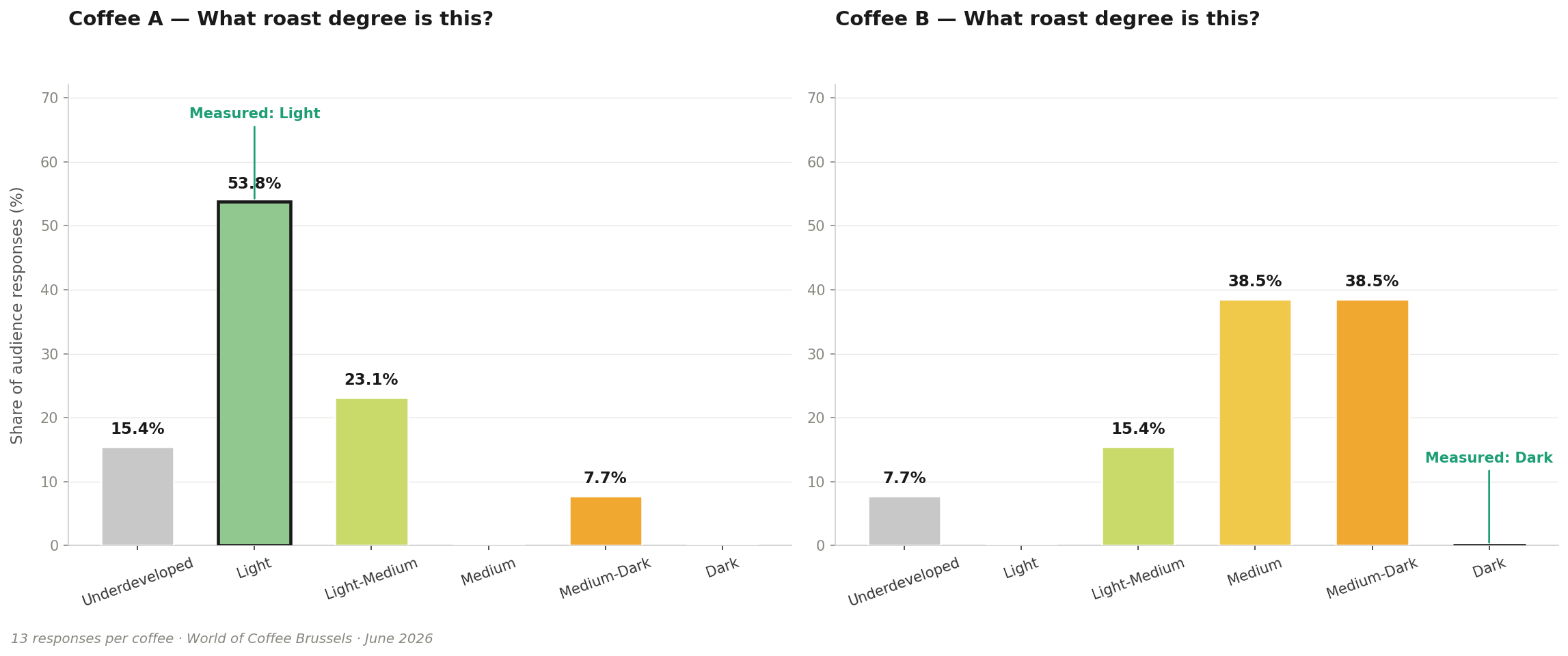
That split is the more interesting finding of the two. If a room full of coffee professionals cannot agree on what dark roast tastes like when given a genuinely dark roast, the problem is not the room. It is the absence of a shared definition. Dark roast, as a category, has never been pinned to a measurable standard the way light roast increasingly has. Everyone recognizes it when it is extreme — but the boundary where medium-dark becomes dark is apparently far less settled than the industry's casual use of the term suggests.
I would like to repeat this experiment with a larger dataset and a wider range of dark roast samples. A single Kenyan coffee is not enough to draw a firm conclusion, but it is enough to suggest that the question is worth asking properly.
The question that mattered more
The most valuable moment of the workshop was not anything I presented — it came from the audience. Someone asked: does it make more sense to roast in a way your customers prefer, or in a style you find personally interesting as a roaster?
It is a fair question, and not one with a single correct answer. But it is also a question that measurement can actually help answer, regardless of which side of it a roaster falls on. Collecting real preference data — roast color, extraction yield, TDS, recorded against actual customer response — reveals exactly what your customers prefer. It also reveals whether your roasting is staying true to the personal style you believe you are expressing, or whether instinct has quietly drifted from intention over time.
Without that data, the choice between customer preference and personal style is not really a choice at all. It is a guess dressed up as a philosophy. Measurement does not tell a roaster which path to take. It tells them, honestly, which path they are actually on — and whether the cup in the customer's hand matches the one in their head.
